Featured

Deep Woods Elk Rifle

Elk hunting, at least my version of it, consists of long days afield, only occasionally interrupted by success. Between the moments of excitement, my mind tends to wander towards custom rifle builds.

Shortly after moving to Montana, my wife and I focused our elk hunting efforts in the densely forested mountains around our home. Opportunities at elk were fleeting, and when they did present themselves, it was far more likely to be at bayonet ranges, not the ultra-long-distances all the rage these days. On one of these hunts, the idea for a custom rifle began to take hold.

My plans for a custom build rarely follow the same thought process. Usually a specific pursuit, such as pronghorn on the prairie, or whitetails in the forest offers the germination of the platform. Other times, a particular action may pique my interest, which then dictates the allowable chamberings, and I continue to tumble down the rabbit hole from there. This time around, the idea called for a svelte rifle with quick handling characteristics and an easily accessible safety, such as the tang safeties found on fine doubles. With this in mind, the action of a choice became the Ruger No. 1.

Introduced in 1967 by Strum Ruger & Co, the No. 1 action is loosely based on the classic British Farquarson action and offers a solid starting point for a classically styled stalking rifle. Further, a No. 1 action measures approximately 4 inches shorter than a standard length bolt action. The extra length saved on the action can then be added to the length of the barrel, thereby maximizing potential muzzle velocity, while still keeping the overall length of the rifle no longer than a standard bolt action. For example, a bolt rifle with a 22″ barrel would have the same overall length as a No. 1 with a 26″ barrel. While sizzling velocity is not a requirement in this build, I didn’t necessarily wish to handcuff a round’s potential by mating it to a stubby barrel, either. By using the No. 1 as the basis of my build, I could construct a compact rifle without sacrificing muzzle velocity.

What I wanted was a sufficiently powerful rifle that would allow me to capitalize on whatever opportunity presented itself, no matter how oblique the shot angle. The magnums would obviously fit the bill, but the range afforded by these chambering would be needless in the dark timber we haunted.

I typically build my rifles around obscure classic cartridges, and this project was no different. A well-timed article in Bugle by Wayne Van Zwoll titled “Modesty with Muscle” introduced me to the 35 Whelen as an elk round. If van Zwoll was right, I had just found the round to build my rifle around.

Created in 1925 in a joint venture between Col. Townsend Whelen and James Howe, the 35 Whelen is essentially a 30-06 necked-up to .358″. Firing a 250 gr bullet at 2,600 fps, the Whelen’s performance crowds in on the venerable .338 Winchester Magnum, but without the sharp recoil or muzzle blast. I’m not a huge fan of arguing the “efficiency” of one caliber over another, but it’s worth mentioning that the Whelen achieves this performance burning a scant 55 grains of powder, versus the .338’s 71 grains of powder. The Whelen achieves this not through some sorcery of case design, but by virtue of having a larger bore diameter, which provides a greater bearing surface for the burning powder to do its work.

While not nearly as abundant as the more popular calibers, handloaders still have access to enough components to keep their presses busy. For my purposes, the 250 grain Nosler Partition would be the bullet I’d build my barrel, and subsequently the rest of my platform around.

For this build, I selected a number 4 contoured 25″ Douglas Air-Gauged premium barrel. Douglas offers three twist rates for the .358 caliber: 1:16″, 1:14″, and 1:12″. Given that the purpose of this build was to create a rifle for elk hunting, I stuck with the 1:12″ twist rate for its ability to stabilize bullets exceeding 250 grains. Yes, exceeding. A brief perusal of http://www.midwayusa.com revealed that the current suite of 35 caliber rifle bullet offerings included the afore mentioned 250 grain Nosler Partition, a 280 grain Swift A-Frame, and a 310 grain Woodleigh Weldcore. Serious medicine for even the largest North American game animals! Velocities for these heavyweights are modest, and trajectories reflect that. Remember, however, this platform was built for scenarios where shots are more likely to be under 200 yards than over. With that in mind, does the point of impact at 400 yards really matter?

One snowy day on the mountain, I was slipping quietly through an elk bedding area. Branches heavily laden with snow unleashed their burden as I brushed by, eventually obscuring the objective of my scope. While it didn’t cost me an opportunity that day, the experience lead to the idea of having iron sights as a back-up when the cover was particularly thick, or for still-hunting in inclement weather. Since I wouldn’t use them unless very close to the target, the iron sights would be regulated for a load utilizing the 310 grain Woodleigh Weldcore roundnose, trundling along at approximately 2,150 fps. The trajectory of this load would be plenty flat for as far as I can reasonably hit with irons. As for the sights themselves, a New England Custom Gun Masterpiece front sight and single folding rear sight fit the bill nicely. A pair of Talley quick-release low-set scope rings would allow access to the iron sights with two quick twists of a lever. A custom quarter-rib and barrel-band sling stud rounded out the remaining barrel furniture. All metal work, save polishing and bluing, was completed by Dennis Erhardt at Frontier Gun Shop in Helena, MT.

Dennis gave the action a few modest upgrades, including inletting the safety tang, an upgraded trigger, and used a surface grinder to true the flats.

Gordon Alcorn (see more of Gordon’s work here) did a bit of engraving on the screw heads, stippled the quarter rib and front sight ramp, engraved a hallmark on the barrel, and caliber designation on the quarter-rib. In my third and final class with Steven Hughes, I gave all the parts a traditional slow rust bluing to finish off the metal work.

A modestly figured piece of English walnut, sourced from Jim Bisio at Heritage Walnut was selected for the stock. Jim’s a wizard with a duplicator, and roughed this stock in for me, which saved a pile of time and energy.

I used Steven Hughes’ time-tested stock finishing technique, which includes the judicious use of Behlen’s Solarlux to enrich the tone of the walnut. Not every stock needs it, but in this particular application, the effect was stunning. You can read more about Steve’s finishing technique in his excellent book “Double Guns and Custom Gunsmithing“.

For glass, I chose to top the rifle with the now discontinued Leupold VX-3 in 1.75x-6x. The 32mm objective allows me to keep the scope mounted low, which is aesthetically pleasing and lessens the compromise required for the drop at heel to accommodate shooting iron sights and/or a scope.

Once completed, I found that a hot load of IMR 4064 capped with the afore mentioned 250 grain Nosler Partition would pound tight cloverleafs with little effort on my part. In fact, the first 10-shot break-in string cut one big hole! Velocity averaged 2,640 fps out of the 25″ Douglas barrel. Sighting 3 inches high at 100 yards puts the point of impact only 9 inches low at 300. That kind of trajectory takes little thought to place lethal shots on animals the size of deer and elk at any reasonable hunting distance.

First range session with the newly finished rifle.

As much as I wanted to christen the rifle on an elk hunt, the first game animal taken was actually a handsome pronghorn buck; not exactly the heavily muscled wapiti the rifle was built for! As an aside, while I would not consider the 35 Whelen the ideal antelope cartridge, the heavy bullet, moving at a moderate velocity resulted in less blood-shot meat than a round from one of the ultra-fast magnums. On smaller big-game (e.g. deer and antelope) meat loss is minimal if the shot is placed correctly, tight behind the shoulder.

At this point, the rifle has cleanly taken pronghorn, whitetail deer and elk. I’m quite pleased with the entire package, and look forward to the Whelen joining me on long walks afield in the future.

Bringing Order to the Chaos

For the last several years, I’ve been trying to devise a way to keep my projects in various stages of completeness organized, protected and out of the way. I should have known the gunmaking craftsmen on the other side of the pond would have had this problem sorted out long ago. And so it was, while reading the excellent Westley Richards Explora blog that I found my inspiration.

The design is simple and very functional: four tall compartments house stocks and barreled actions. Each compartment has small hooks to hang freshly oiled stocks and bins to keep track of all the small parts.

Initially, I had ordered plastic bench bins to organize the small parts; this was functional, but “how you do one thing is how you do all things”, and these bins never quite looked right. To solve this, I ordered a lock-joint mitre and built some proper wooden boxes. A bit of cork sheeting on the bottom of the boxes softens the floor to protect delicate metal edges. The bins can be completely removed and carried to my workbench while work is completed on that particular project. The locker and bins were painted using Sherwin-Williams’ “Pristine Wilderness” green, which not only seemed apropos, but also compliments the rich color of the walnut stocks this furniture will house.

A set of brass locker numbers keeps the projects and their corresponding bins aligned. This is particularly useful in the event that I’m working on multiple builds using the same action. A good example of this would be the two pre-’64 M70 projects currently in the shop.

While feeling inspired, I also built a rack to house a portion of my stock blank inventory. This was installed right behind my bench so that I can admire these beautiful blanks while I work.

My workspace would never be classified as “large”, so a bit of thoughtful organization goes a long ways!


A Steampunk Westley Richards

Think what you will of social media, but occasionally it can actually bring some good to the world. Such is the case with this project. Before us, we have a Westley Richards Improved Martini in for restocking. Its current owner, Steve, and I had connected via Instagram and communicated for the better part of a year when the conversation eventually lead to a restocking project.

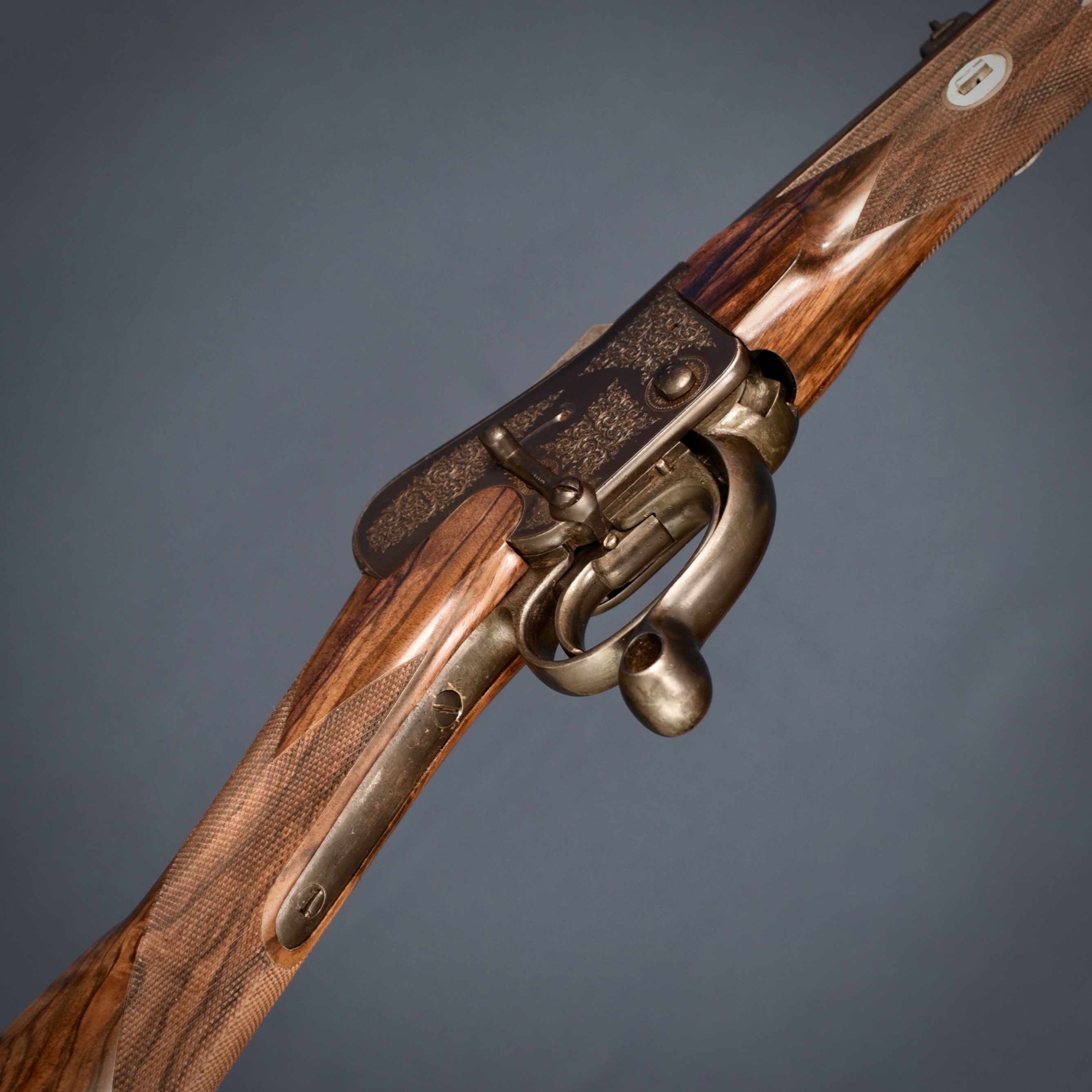
Westley Richards Improved Martini Patent of 1869

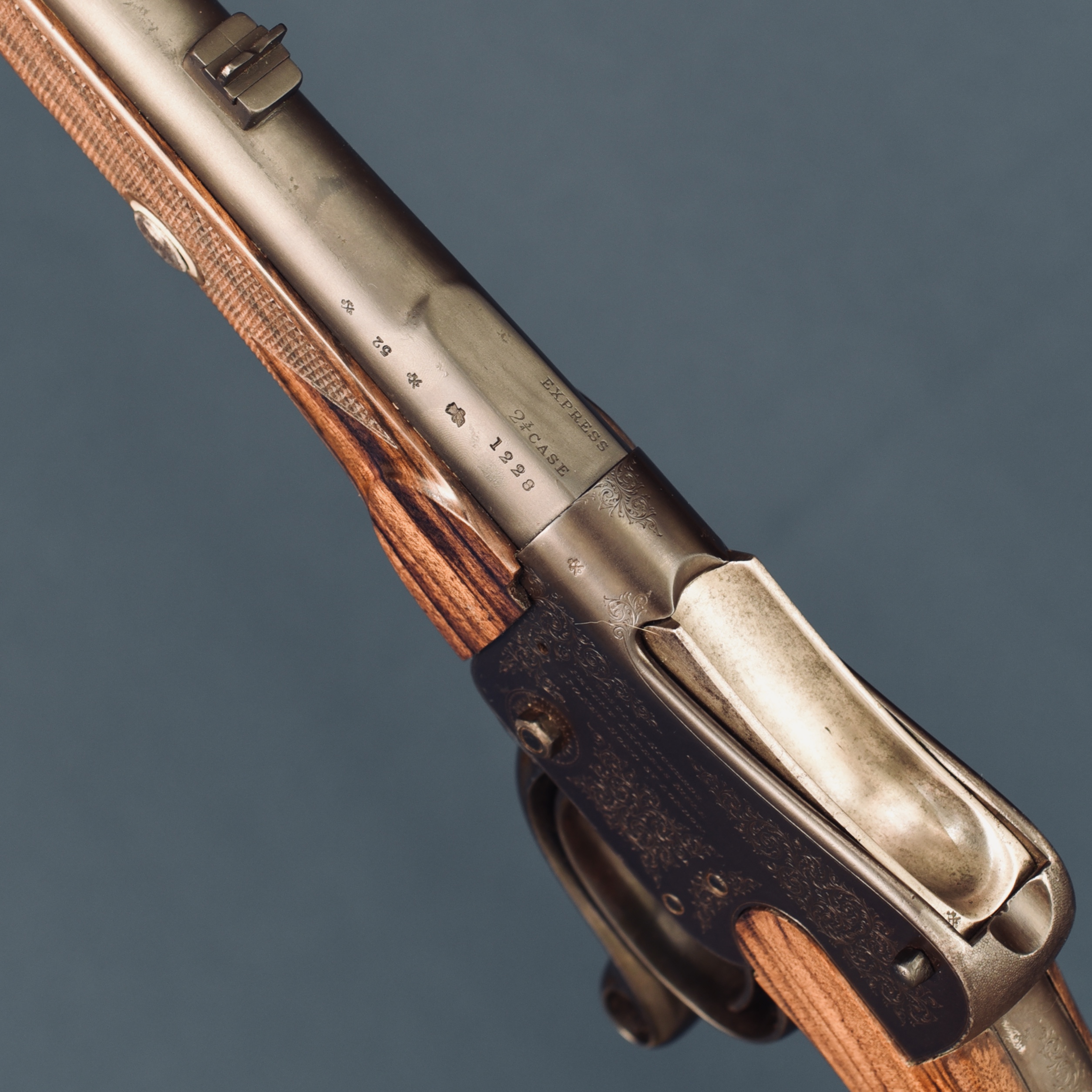
The rifle up for discussion is a Westley Richards Improved Martini, Patent of 1869. In attempting to research the rifle, my calls to Westley Richards met an unfortunate dead end; the company’s archives were incomplete around the timeframe this rifle would have left their shop. So for now, all we know is that rifle was likely constructed some time between 1869 and 1872.

To be honest, I’d never given one of these rifles more than a passing glance prior to this project and knew virtually nothing about them. The action itself is hulking, with levers and humps that distort the clean lines British guns are known for. In our initial meeting about the project, Steve said, “This is as close as Westley Richards ever got to steampunk!” A more apt description eludes me. Nevertheless the nearly-full-coverage scroll engraving is well executed, as is the stippling at the back of the receiver, and a case colored trapdoor buttplate adds a touch of elegance. Westley Richards may have had reservations about using such an action as the basis of a build, but their execution is without compromise!

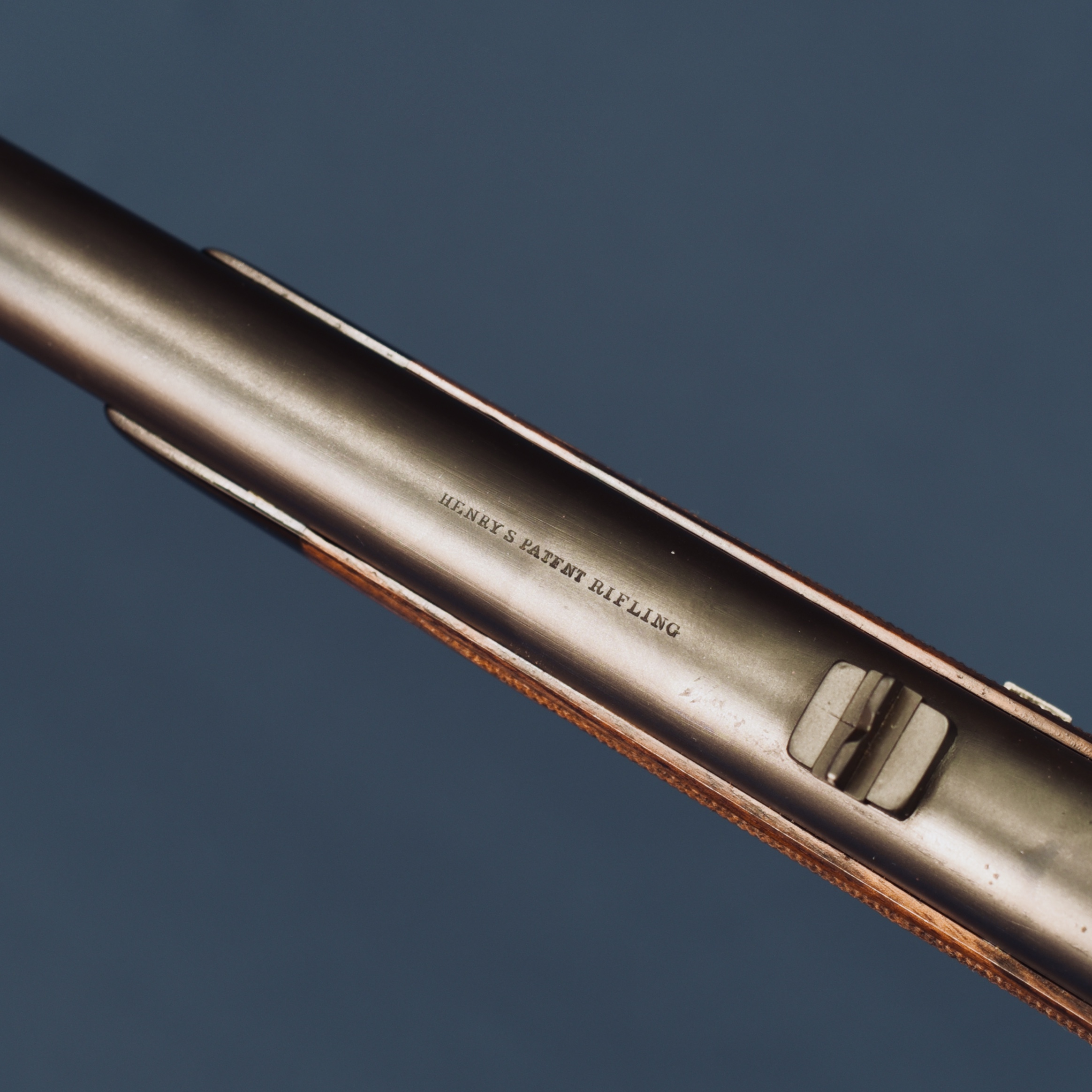
I have mixed feelings about restocking a historic firearm, especially one with a pedigree such as this. However, at some point in this fine rifle’s 150 year lifespan, the 28″ barrel had been bulged, rendering it unusable. Steve had Dennis Erhardt at Frontier Gun Shop in Helena, MT remove the bulge and sleeve the barrel to .458 caliber, then slow-rust blue the metal. Knowing that the rifle had already been thusly altered, I had no qualms about dressing it up in an elegant stick of walnut!

Rifle #1228 was originally chambered in .500-450 2 3/4″ BPE (or .450 No. 1 Express). According to Wal Winfer in British Single Shot Rifles Volume 4, Westley Richards would have regulated the .450 No. 1 Express with 100-127 grains of blackpowder under a 270-320 grain bullet. Pressures for such a load would be comparatively minimal, so in keeping to these parameters, the newly sleeved barrel was chambered for 45-70 Gov’t. After a brief discussion to explore stylistic options, I set to work on the new stock.

The first order of business was to evaluate what we had to work with. I was relieved to remove all the stock furniture without incident, carefully inventorying each piece for use on the replacement stock. It’s always nerve-wracking to work with small parts made from “unobtainium”, but it was quite a joy to dismantle, admire, and inspect such high level of craftsmanship. I marveled at the oringal maker’s skills as each benchmade item was withdrawn from the wood.

In dismantling the rifle, I immediately noticed that the top left side of the forend was broken its entire length. I rebuilt this area using Acraglass so that the original stock could be used as a pattern.

For wood, Steve chose to use one of the blanks I already had on hand. The blank itself was sourced from Cecil Fredi and had been aging in the dry Nevada heat for 11 years before I purchased it in 2017.

Once the original stock had been rebuilt, it and the blank were shipped to Gene Similion for duplicating. Always the consummate professional, Gene turned the blank around in record time and had the wood back to me in under 30 days. Its always exciting to see what the figure does when a square blank is shaped into the round. I wouldn’t have called this blank a “sleeper”, but it went up at least one full grade once it was machined. I kind of wish I would have kept it for me!

The new stock wetted with rubbing alcohol to reveal the figure.

Steve wanted to keep the stock as authentic as possible, so in addition to reusing the original forend key, trapdoor buttplate, and sling stud, we decided to use horn for the forend cap. Sourcing a 2″ x 2″ block of horn proved to be a bit of a challenge, but in the end, I was able to find a supply of asiatic water buffalo horn on eBay. I ordered two blocks as a hedge against Mr. Murphy inviting himself to the party.

As the project evolved, Steve asked if the trap-door butt plate could be replaced with a classic Silver’s recoil pad. Although a considerable amount of time had already been devoted to fitting the steel plate, I couldn’t argue against the utilitarian virtues of a rubber recoil pad. In the end, I think the red pad was a great choice, even if it wasn’t original.

McLaughlin’s Old World Stock Finish was used to produce an in the wood finish, and 20 or more lightly buffed coats of Daly’s SeaFin were used as a top coat. After all, if Daly’s SeaFin is sufficient to protect teakwood on sailboats in the salty pacific northwest, then surely it should turn the trick on gunstocks!

I’m a bit biased, but I love the way the highly figured walnut of the new stock compliments the original metal work. The long barrel, complete with proof marks and original caliber designation harkens to time when an officer in the British Army may have taken this rifle to the jungles of India in search of leopard, chital, or even tigers.

Checkering was cut at 24 lines per inch in a simple point pattern approximating the style used on the original stock.

Steve says he’ll hunt the old rifle this fall, and I can’t wait to see some field photos. It’s tantalizing to think about all the places this Westley might have traveled in its century-and-a-half of existence.

The old rifle with new stock and high quality leathergoods from Westley Richards.

Here’s to another 150 years of use for Westley Richards #1228!

Restocking the Rizzini

My accountant, Van, is a passionate bird hunter which is probably why we work so well together. About a year ago, while completing the final details on my taxes, the conversation naturally turned to gundogs and shotguns. Van had recently ordered a Rizzini Artemis Light Hunter in 16 gauge as a special treat, and a testament to his passion for upland hunting. Although he specified upgraded wood, what he ultimately received left a bit to be desired. Further, the Prince of Wales grip on the Rizzini never felt “right” in Van’s hands. What’s worse, another ‘smith had attempted to “improve” the grip by scabbing on a piece of walnut in an effort to allow more purchase. The result was as you can imagine.

The Rizzini in it’s not-so original state. Note the modified grip radius. Yikes!

Van asked if I’d be interesting in restocking his otherwise lovely over/under. I welcomed the opportunity to give my friend exactly what he was hoping for when he placed the initial order at the factory.

I immediately set to work to source a suitable blank. None of the blanks on hand were to Van’s liking, so a call to Cecil Fredi in Las Vegas, NV was in order. Cecil never disappoints, and soon we had a plethora of options to choose from. Ultimately, we settled on a blank that was the perfect combination of layout, figure, color, and budget.

Stock blank selected for the restocking project

Using the original stock as the pattern, I reworked the grip area into a traditional full pistol grip. Closing the radius of the grip necessitated moving the nose of the comb forward to maintain the proper stock geometry. Prior to the Rizzini, Van had been shooting a Beretta with a schnabel forend tip. I’ve always found that stylistic feature to be an impediment to my form of instinctive shooting, but Van insisted it helps to consistently position his right hand on the forend. I have to say, after it was added to this stock, I rather liked the look of it! An English style steel grip cap from Dressels finalized the redesign of the buttstock, and then the pattern and blank were shipped off to Gene Simillion for machining.

Van tallies more days afield in one season than most guys do in a decade. Resultantly, a traditional checkered wooden butt on this gun would be antithetical to the use it would see, and plastic not classy enough. I offered to install a leather-covered recoil pad, but Van requested a blued steel buttplate instead.

Details of the widow’s peak steel buttplate

The stock was finished using an “in-the-wood” technique that will provide protection against years of honest use. Checkering was done in a simple point pattern at 24 lines per inch.

Overall, I was quite pleased with the way this project turned out, and was eager to send it home in time for the 2019 upland opener. A week after opening day, I phoned to ask how the shotgun had performed. Van was happy to report that he and the Rizzini were batting 1.000 on two limits of roosters. Music to my ears!

A Swede for Tricia

My wife Tricia is a patient woman. And just as the cobbler’s kids have no shoes, she was the last to receive a project from my bench. It was time to fix that.

Years ago, while wandering around the Bozeman gun show, Tricia and I found a Ruger M77 Express in 30-06 that she just couldn’t live without. So with a proper “elk gun” already in her arsenal, we set out to build her the ideal rifle for pronghorn and deer.

Tricia and her M77 Express on a very cold late November elk hunt!

Identifying the quarry helped to quickly narrow the litany of potential chambering for this project. I’ve been a huge fan of the .270 Winchester for years, but that was ballistically too close to the ’06 to be a viable choice for this build. The latest 6.5 craze caught my attention, but the Creedmor was immediately ruled out. Yes, it’s a fine cartridge, just too trendy for my tastes. The .260 Remington seemed interesting but not enough “quirk”, and the 6.5-284 Norma and 6.5-300 Weatherby were deemed too snorty. Ultimately, we settled on the 6.5×55 Swedish Mauser because it ticked all the boxes: sufficient power for our purpose, ample reloading supplies, and it’s uncommon enough to be a topic of conversation at hunting camp. Check, check and check.

The 6.5×55 Swedish Mauser was first developed way back in 1891. Out of reverence for the historic firearms so chambered, SAAMI approved pressures for this cartridge are a bit anemic by today’s standards, especially compared to the approved pressures for its peers in the 6.5mm cohort. Check the Swede’s case capacity against that of the .260 Remington, or 6.5 Creedmor and one can quickly see that the 6.5×55 is capable of more than the factory rounds give it credit for!

At some point along the way, I had obtained a clean pre-64 M70 action. Using this as the basis of our build, I reached out to Dennis Erhardt at Frontier Gun Shop to thread and chamber a barrel. We selected a 23″ #2 contoured Douglas Air-Gauged barrel for this build, with a 1:8″ twist rate to best stabilize the heaviest 6.5 bullets we might choose to utilize. As an aside, it’s those long, heavy for caliber bullets (140 grains and up) that gave the 6.5×55 its well earned reputation for felling Scandinavian moose. Knowing how our deer hunts can quickly turn into elk hunts here in Montana, I quickly developed an appreciation for the Swede’s understated competency!

Even with its bullets seated all the way out, the 6.5×55’s overall cartridge length specs at 3.150″. That’s a bit shorter than the 30-06 and its 3.340″ OAL this action was built for. Regardless, feeding issues were minor and easily resolved through a simple modification to the follower spring. John McLaughlin at McLaughlin Custom Firearms detailed the original trigger until it broke like glass at just over 3 lbs of pressure.

Jim Bisio of Heritage Walnut machined a lovely quarter-sawn english walnut blank to fit our build. The grain in the wood was stick-straight with tight pores, and it carved like a bar of soap. A real pleasure to work with! An ebony forend tip, Fisher two-screw grip cap, and a pair of Bisio’s ball head sling studs rounded out the additional stock features.

Work in progress

The length of the forend is in keeping with the “golden ratio” of proportion and the double-hook cheekpiece was scaled to compliment my wife’s 13.00″ length of pull. There’s virtually no drop at heal in the stock as this rifle will always wear a scope.

Gordon Alcorn at Alcorn Engraving engraved the caliber designation and maker’s mark on the barrel, and added a lovely American-style scroll motif on the original floorplate. All metal was slow rust blued, with the exception of the extractor, which was nitre blued.

Gordon Alcorn’s handiwork. Top shelf stuff!

A set of Leupold “low” rings secure a VXi 2.5x-8x scope, which with its 36mm objective is proportionate to the overall scale of the rifle.

We tried many combinations of components, but found the rifle loved 130 gr Swift Scirocco II’s over a medium charge of H4831SC. Recoil is very mild, and when compared to the mass of some of my elk rifles, Tricia’s Swede feels like a graceful wand in the hand.

It’s intensely satisfying to see a rifle from my bench out in the field, and doubly so when it’s my wife behind the trigger! Since completion, Tricia and her Swede have taken both pronghorn and whitetail deer with no signs of slowing!

A beautiful doe antelope taken along Montana’s Rocky Mountain Front